

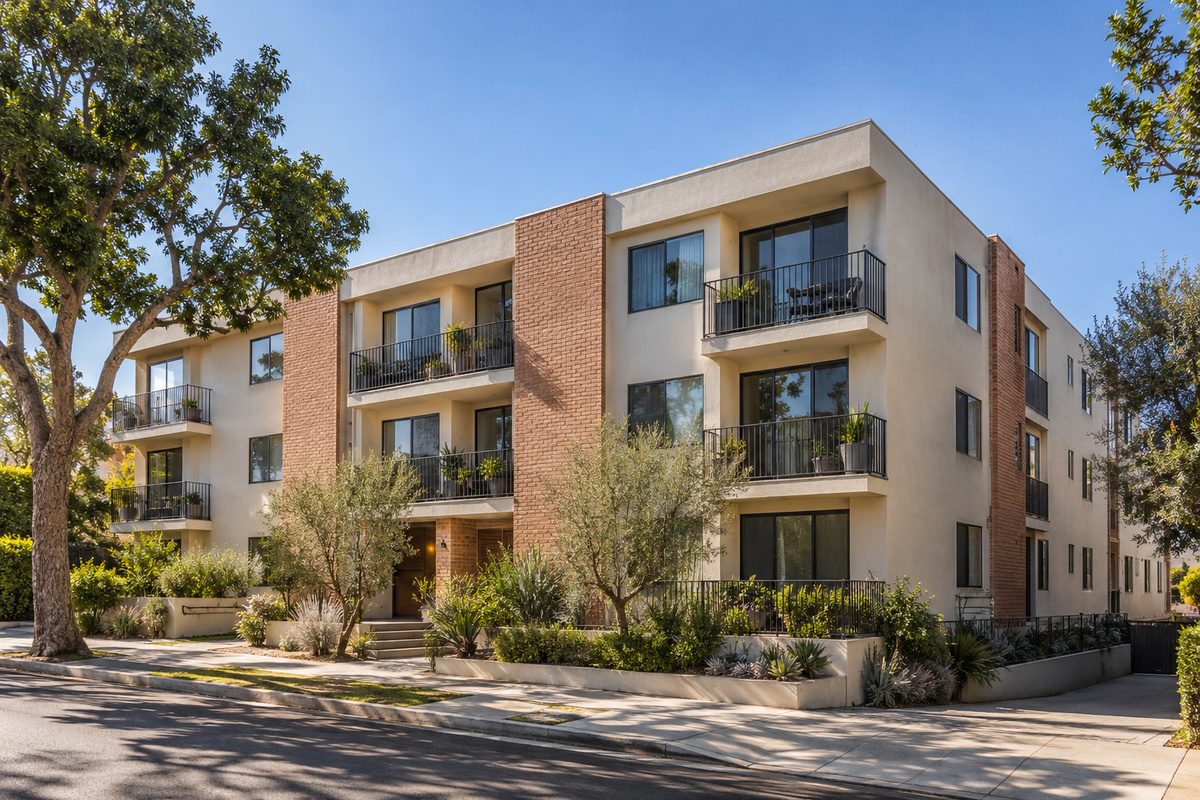
I sell apartment buildings in Los Angeles for a living, and the most common call I get right now is not from a buyer. It is from an owner who has held a 10 to 30 unit building for twenty or thirty years and wants to know what it is worth, because they are done.
These are not corporations. They are families who bought a fourplex in Van Nuys in the nineties, or a 16-unit in Encino with a 1031 from a duplex. They managed it themselves, kept rents reasonable, and planned to hand it to their kids. Now they are calling me to list it.
The public conversation treats this as tenants versus landlords. That is not what I see. What I see is a set of costs the owner cannot control rising faster than the income the law allows them to collect, and a growing list of ways to get sued for paperwork. Below are the numbers, from the actual sources, so you can judge for yourself.
Conserving water does not lower the bill
LADWP has not raised its base water rate since 2019. It has not needed to. The all-in Tier 1 rate for apartment buildings went from about $7.29 per hundred cubic feet in early 2022 to $11.59 in early 2026, a 59% increase, entirely through pass-through adjustment factors that get reset twice a year. The Water Infrastructure factor alone went from $0.51 to $2.90, nearly six times.
One of those factors, the Base Rate Revenue Target adjustment, exists specifically to recover revenue lost when customers use less water. So an owner who installs low-flow fixtures and cuts consumption watches the per-unit price climb to make up the difference. That is how the system is designed. LADWP trimmed the infrastructure factor in July 2026 and the rate is now about $10.89, still roughly 49% above where it sat four years ago.
Trash became a revenue line for the City
In July 2017 Los Angeles replaced the open market for commercial and multifamily trash hauling with RecycLA: 11 exclusive zones, seven franchise haulers (six today, after Athens bought CalMet). The City collects roughly $35 million a year in franchise fees from those haulers, and that money goes to the general fund with no restrictions on how it is spent. The haulers pass it through to you.
The bigger hit was never the base rate. It was the add-ons. Access fees, distance fees, bin-pull fees. Owners reported bills that doubled or tripled; one Reseda complex went from $187 to $722 a month for the same service. In 2024 black-bin access and distance fees alone totaled about $60 million citywide. Rates went up another 5% on January 1, 2026 under the contract escalator.
If you own one to four units, you were hit from a different direction. In April 2025 the Council voted 10 to 1 to raise the City-collected Solid Resources Fee to $59.53 per unit per month starting January 2026. For a triplex or fourplex that was $24.33, an increase of about 145%.
The one piece of good news: the new RecycLA contracts that start in February 2027 eliminate access, distance, weight and fullness fees. Watch the new administrative fee that replaces them.
Income is capped. Costs are not.
Everything above went up double digits. Here is what the owner is allowed to collect.
| Jurisdiction | Formula | Allowable increase, July 2026 to June 2027 |
|---|---|---|
| City of Los Angeles (RSO) | 90% of CPI, 1% floor, 4% cap | 3% |
| Unincorporated LA County (RSTPO) | 60% of CPI, 3% cap (+1% for owners of 10 or fewer units) | 1.919% |
The City formula is new. In December 2025 the Council voted 12 to 2 to replace the old rule (100% of CPI, 3% floor, 8% cap, plus 1% to 2% for owner-paid utilities) with 90% of CPI inside a 1% to 4% band. The utility add-ons are gone. The 3% floor is gone. In a low-inflation year a City owner can now be held to 1%. The County went further in November 2024: 60% of CPI, which produced 1.93% last year and 1.92% this year.
Now the other side of the ledger. When a tenant stops paying, you cannot serve notice until the arrears pass a threshold tied to HUD Fair Market Rent, not the tenant’s actual rent. In the City that is one month of FMR. In unincorporated County it became two months in April 2026, on a 4 to 1 Board vote. FMR for a two-bedroom is $2,601, so a County tenant paying $1,800 has to fall nearly three months behind before the clock even starts. Add a contested unlawful detainer at two to four months and the owner is carrying four to six months of zero income on that unit. On a fourplex, that is a quarter of the building.
And because Costa-Hawkins still allows a reset to market at turnover, the rational owner does exactly that. Tight caps do not keep rents low. They make the one legal rent increase as large as possible.
Paperwork is now a legal exposure
In 2023 the City added a requirement that a non-payment notice state the number of bedrooms in the unit, so the court can check it against the FMR threshold. Leave it off and the notice is defective. Tenants have beaten evictions on that basis, and when a tenant wins at judgment under a lease with an attorney fee clause, the owner pays the tenant’s lawyer. One 2026 appellate case affirmed a $69,560 fee award. To be fair about the law: if the owner catches the defect and dismisses voluntarily, there is no prevailing party and no fee award. The owner just starts over, months later.
The tenant’s lawyer is often free to the tenant. Measure ULA, the transfer tax on sales above $5.4 million, puts 10% of its program money into eviction defense. The current fiscal year earmarks $54.4 million for the Legal Aid Foundation of Los Angeles, and in March 2026 the Council approved a $177 million Stay Housed LA package. ULA has collected $1.19 billion since 2023 and survived every court challenge. It is not going away.
So the owner is funding, through a tax on the sale of their own building, the attorney who will defend the tenant who stopped paying rent. Whatever you think of the policy, understand the incentive it creates for anyone deciding whether to keep owning rental housing in this city.
Add the posting requirements. The City requires a Notice of Renters’ Protections and a Notice of Right to Counsel in the common area, plus the RSO registration. Failing to post the first one is a misdemeanor under the Municipal Code and gives the tenant an affirmative defense to eviction. Not a fine. A misdemeanor, for a missing flyer.
What the market is actually doing
The debt is the accelerant. A five-year loan written in 2021 at 3.5% to 4% is maturing into a market where small-balance agency money prices around 6.15% to 6.75% and floating rate paper sits higher. That is 250 to 300 basis points on a building whose rent growth has been held to 2% or 3% a year. For a lot of owners the refinance does not pencil, and the building goes to market.
You can see it in the data. LA multifamily sales volume was up 39% year over year in the second quarter of 2026, while cap rates rose for the sixth straight quarter to 5.4% to 5.8% depending on whose numbers you use. More sellers, lower prices. Ellis Act withdrawals continue at several hundred to over a thousand units a year on top of that.
I want to correct one thing you will hear at industry events: private equity is not circling your 12-unit in Sherman Oaks waiting for a 9 cap. The institutional buyers active in LA this year bought 200 to 400 unit assets. The buyers for small rent-controlled buildings are still private, mostly local, often exchange money. The difference from five years ago is that they are underwriting your real expenses and your real allowable increases, not a pro forma, and they are pricing in the risk of the next ordinance.
That means three things if you own:
Know your true number. Pull your actual LADWP, hauler, insurance and tax line items for the last four years and run them against your rent roll under the new formula. Most owners I sit down with have not done this and are surprised.
Know your loan date. If you reset in the next 24 months, start the conversation now, not at the maturity notice.
If you are going to sell, sell into a market with buyers, not after the next policy change. The County’s COPA proposal, which would give nonprofits a first look at 5+ unit buildings in unincorporated areas, is due in draft around January 2027. It has not passed, and the City’s version has gone nowhere since 2024, but it tells you which way the wind blows.
Showing up still works
One more number worth knowing. In November 2025 the Council’s Housing Committee sent a rent formula to the floor at 60% of CPI with a 0% floor and 3% cap. That would have meant zero increases in a low-inflation year. Owners and the apartment associations packed the chamber, tenant groups packed it right back, and after a two-hour hearing the full Council replaced it on the floor with 90% of CPI and a 1% to 4% band, 12 votes to 2. Not a win for owners. But a very different outcome than the one that walked in the door.
The lesson is not that owners can stop every ordinance. It is that the small owner is invisible in this debate until they show up in person with their actual numbers. Councilmembers hear from advocacy organizations every week. They rarely hear from the woman who owns the eight-unit on Magnolia and is deciding whether to keep it.
If you are that owner, two things. Join the association and go to the hearings, because the alternative is being regulated by people who have never seen your P&L. And get a real valuation before you decide anything, because the choice between holding and selling is a math problem, and the math has changed.
I run those numbers for owners every week. If you want yours, reach out.
One West Group | eXp Commercial
Investment Advisory | Capital | Brokerage
Sources: LADWP biannual notices of change in water rates (July to December 2022, July to December 2026); Waste Dive and LASAN recycLA 2.0 on RecycLA; AAGLA on the Solid Resources Fee; LAHD and AAGLA on the RSO formula; LA County DCBA and Supervisor Hahn on County rules; LAHD ULA report, June 2026; Matthews and Lee & Associates Q2 2026 multifamily reports; LAist on the County COPA vote; Spectrum News on the November 2025 Council vote.
Market commentary dated November 8, 2026. This article is provided for general information and does not constitute legal, tax, lending, or investment advice. Property owners should consult qualified attorneys and professional advisers regarding their individual circumstances.